
The FBA Prep Guide for UK Amazon Sellers 2026

If you sell on Amazon, you already know that getting products to the warehouse is not as simple as sticking on a label and booking a courier. One small mistake with packaging or barcodes can lead to refused deliveries, stranded inventory, penalty fees or even account health warnings.

That is where the FBA prep comes in.
Whether you are launching your first private label product or scaling a wholesale operation into the UK marketplace, understanding the FBA prep process can save you thousands of pounds and a great deal of stress. In this in depth guide, we will break down exactly what the FBA prep involves, how it works step by step, the pros and cons of outsourcing it, and whether using a professional service such as FastPack FBA is the right move for your business.
What Is the FBA Prep?
The FBA prep refers to preparing your products so they meet Amazon’s strict fulfilment standards before they are sent into Fulfilment by Amazon.
If you sell through Amazon UK and use Fulfilment by Amazon, your inventory must comply with detailed rules covering:
Packaging requirements
Labelling standards
Product condition checks
Expiry date handling
Bundling instructions
Fragile item protection
Amazon publishes comprehensive guidance within Seller Central. If products arrive incorrectly prepared, they may be:
Rejected at the fulfilment centre
Marked as unfulfillable
Subject to unplanned prep fees
Returned at your expense
Flagged against your account health
In simple terms, the FBA prep is the quality control gateway between your supplier and Amazon’s warehouse network.
While some sellers attempt to manage this process in house, many quickly realise that it is far more complex and labour intensive than expected.
Why the FBA Prep Matters More Than Ever in 2026
The UK ecommerce landscape is more competitive than ever. According to data from Office for National Statistics, online retail continues to represent a significant portion of total retail sales in Britain. Amazon remains a dominant marketplace, and compliance standards have tightened year after year.
Amazon warehouses now operate at immense scale and speed. Their systems are automated, barcode driven and efficiency focused. That means there is very little tolerance for errors.
Common issues we see at FastPack FBA include:
Missing FNSKU labels
Incorrect barcode placement
Inadequate polybag sealing
Insufficient bubble wrap for fragile goods
Mixed inventory that has not been sorted correctly
Incorrect case pack quantities
Even small oversights can cause large delays, especially during peak Q4 trading.
The FBA prep is no longer a side task. It is a core operational function.
What Does a Professional FBA Prep Centre Actually Do?
A proper FBA prep partner does far more than stick labels on boxes.
At FastPack FBA, the FBA prep process integrates directly into your supply chain. We act as a controlled checkpoint between your supplier and Amazon’s fulfilment centres.
Here is what that typically involves.
1. Receiving Inventory
Your stock arrives at our warehouse, either directly from UK suppliers or imported from overseas manufacturers.
We check:
Delivery quantities
Carton conditions
Visible transport damage
Documentation accuracy
For sellers importing from China or Europe, this stage is critical. Freight damage and supplier packing errors are more common than many realise.
2. Detailed Inspection
The inspection phase is one of the most valuable parts of the FBA prep.
Depending on your instructions, we can:
Conduct random sample inspections
Perform full unit checks
Verify variations
Check product quality and condition
Confirm correct accessories and inserts
For example, a private label seller launching a new kitchen gadget may request full inspection of the first shipment to ensure quality consistency before it reaches Amazon customers.
Catching defects early prevents negative reviews and costly returns.
3. Sorting and Inventory Management
We sort units by SKU, variation and shipment plan. Mixed pallets from suppliers are separated correctly so they align with Amazon’s shipment creation requirements.
We log inventory into our tracking system, allowing you to see stock levels and movement in real time.
4. Packaging to Amazon Standards
Amazon has strict requirements for:
Polybags with suffocation warnings
Opaque packaging for adult products
Bubble wrap for fragile items
Sealed sets and multipacks
Expiry date formatting
If products do not meet these rules, Amazon may apply unplanned prep services at premium rates.
The FBA prep ensures your items comply before they leave our warehouse.
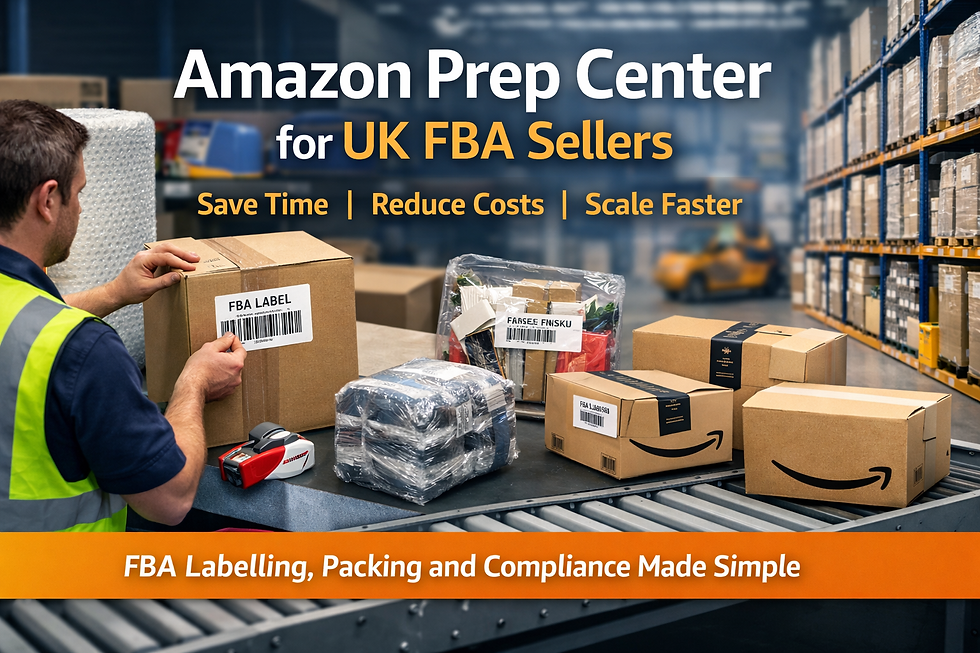
5. Labelling
Labelling is one of the most misunderstood parts of the FBA prep.
Each unit typically requires an FNSKU barcode unless you are enrolled in manufacturer barcode programmes.
Labels must be:
Scannable
Correctly positioned
Placed over any existing barcodes
Printed clearly without smudging
Cartons must also be labelled according to shipment plans generated in Seller Central.
6. Storage and Drip Feeding
Rather than sending all inventory to Amazon at once and paying high storage fees, many UK sellers choose to hold part of their stock at our facility.
We then drip feed inventory into Amazon based on:
Sales velocity
Restock limits
Seasonal trends
Cash flow management
This approach reduces long term storage fees and improves stock control.
7. Shipping to Amazon Fulfilment Centres
We coordinate courier bookings, pallet requirements and documentation.
Amazon UK uses multiple fulfilment centres across the country. Shipment routing is determined during plan creation. We ensure cartons meet Amazon’s weight and dimension limits before dispatch.
Step by Step: How the FBA Prep Works with FastPack FBA
To make this practical, here is a simplified overview of how the FBA prep works when partnering with us.
You place an order with your supplier
Supplier ships inventory to FastPack FBA
We receive and inspect stock
You create your shipment plan in Seller Central
You send us labelling files and prep instructions
We package and label products according to Amazon standards
We dispatch inventory to Amazon
You track inbound shipments in Seller Central
This process removes the need for you to handle physical stock personally.
For many sellers, especially those operating from home or remotely, this is transformational.
Pros of Outsourcing the FBA Prep
There are clear advantages to outsourcing the FBA prep to a specialist provider.
1. Time Efficiency
Time is your most valuable resource as an Amazon seller.
Rather than:
Renting warehouse space
Hiring staff
Managing compliance
Printing labels
Booking couriers
You can focus on:
Product research
Supplier negotiation
PPC optimisation
Brand development
Cash flow planning
The FBA prep becomes a managed service rather than a daily operational burden.
2. Cost Control
Many sellers assume in house prep is cheaper. Often it is not.
When you factor in:
Warehouse rent
Business rates
Utilities
Insurance
Staff wages
Equipment
Packing materials
Outsourcing frequently becomes more cost effective, especially at scale.
At FastPack FBA, our pricing structure is transparent and designed for predictable budgeting.
3. Reduced Risk of Amazon Penalties
Compliance mistakes can be expensive.
Unplanned prep fees at Amazon fulfilment centres can quickly add up. Worse still, repeated non compliance may affect your account health.
Professional FBA prep reduces these risks significantly.
4. Scalability
If you suddenly scale from 500 units per month to 10,000 units per month, can your garage based system cope?
A dedicated prep centre is built to handle volume spikes, particularly during Q4 when Amazon demand surges.
5. Better Inventory Flow Management
Holding stock externally allows you to:
Avoid long term storage fees
Manage restock limits
Smooth out supply chain disruptions
Reduce cash tied up in Amazon warehouses
This strategic flexibility is a major advantage.
Cons of Outsourcing the FBA Prep
It is important to consider the potential downsides too.
1. Less Direct Physical Control
Some sellers prefer to physically see and touch their inventory.
Outsourcing requires trust in your prep partner. That is why transparency, reporting systems and communication are critical.
2. Additional Per Unit Cost
Prep services charge per unit or per task. For very small sellers with minimal volume, this may feel like an added expense.
However, the true comparison must include your own time and overhead costs.
3. Choosing the Wrong Provider
Not all prep centres operate to the same standards.
Before selecting a partner, consider:
Warehouse size and infrastructure
Experience with your product type
Turnaround times
Insurance coverage
Client testimonials
Technology and tracking systems
At FastPack FBA, we encourage potential clients to ask detailed questions. Transparency builds long term partnerships.
Does Amazon Offer Its Own Prep Service?
Yes, Amazon does provide internal prep services if inventory arrives non compliant.
However, there are several considerations.
Fees are often higher than independent prep centres
Turnaround times can delay availability
Repeated issues may impact performance metrics
You lose proactive quality control
Amazon’s internal prep is designed as a corrective measure, not a strategic supply chain solution.
Most established sellers prefer to control compliance before goods reach Amazon’s network.
Should You Use the FBA Prep for Your Business?
The decision depends on your stage of growth.
You may benefit from outsourcing the FBA prep if:
You import from overseas
You sell fragile or complex products
You operate remotely
You want to scale rapidly
You are hitting restock limits
You want to reduce Amazon storage fees
You may choose to handle prep yourself if:
You have very low volume
You already own warehouse space
You have trained staff and processes in place
However, many sellers who start in house eventually transition to a professional prep centre as they grow.
Real World Example
One UK wholesale seller approached FastPack FBA after repeatedly receiving Amazon compliance warnings.
Their supplier claimed to understand FBA requirements but:
FNSKU labels were misaligned
Multipacks were not sealed correctly
Carton weights exceeded Amazon limits
After moving the FBA prep process to our facility, their inbound defect rate dropped to zero within two months. Account health stabilised and they scaled product lines confidently.
This is not unusual. Most issues stem from misunderstanding Amazon’s exact specifications.
Frequently Asked Questions About the FBA Prep
What is included in the FBA prep service?
Typically receiving, inspection, packaging, labelling, storage and shipping coordination.
How long does the FBA prep take?
At FastPack FBA, standard turnaround is typically within three working days depending on volume and complexity.
Is the FBA prep suitable for private label sellers?
Yes. In fact, private label brands often benefit the most due to quality control needs.
Can prep centres handle fragile or oversized items?
Yes, provided they have the correct materials and procedures in place.
Is outsourcing the FBA prep worth it for small sellers?
It depends on your growth plans. If you intend to scale, setting up professional systems early can prevent future bottlenecks.
Final Thoughts on the FBA Prep
The FBA prep is not just about sticking labels on products. It is about protecting your account, preserving your margins, and building a scalable supply chain.
In the competitive UK Amazon marketplace, operational excellence matters. Small compliance errors can lead to big financial consequences. At the same time, efficient preparation can unlock smoother growth, better stock management and fewer headaches.
At FastPack FBA, we specialise in reliable, transparent and scalable FBA prep services tailored to UK Amazon sellers. Whether you are launching your first product or managing thousands of units per month, our team ensures your inventory is fully compliant and ready for sale.
If you are ready to simplify your operations and take the stress out of the FBA prep, get in touch with FastPack FBA today and discover how a professional prep partner can transform your Amazon business.



Comments